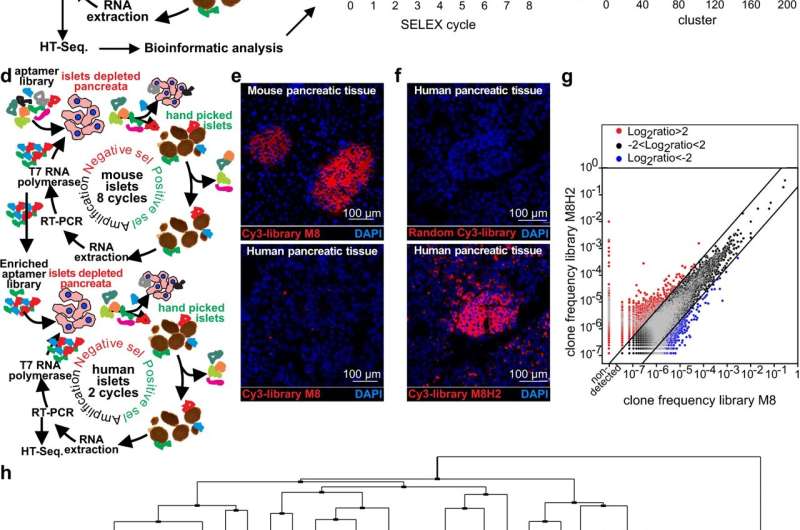
原理图的HT Cluster-cell SELEX。随机图书馆~ 1014随机寡核苷酸适配子是正面和负面的选择对islet-depleted外分泌细胞和胰岛从尸体的捐助者。寡核苷酸适配子被恢复,放大,并用于以下选择周期。胰腺标本4尸体捐助者被用于8选择周期。b库的复杂性在SELEX有所下降。从不同的周期进行了取样cDNA Illumina-based HT-sequencing,和数据分析了适体频率,图书馆的复杂性,和家庭识别。c Clustal发现的集群频率周期8Ω图书馆和寡核苷酸适配子的频率之和从208年的每一个家庭都绘制识别。插入的主成分分析显示5000个最频繁序列。d示意图HT-Toggle SELEX。8个周期(M1-M8)进行选择使用腺泡的细胞和胰岛分离BALB / c小鼠。 Two additional cycles of selection (M8H1 and M8H2) were then performed using acinar cells and islets from one cadaveric donor. cDNA library from cycle M8 and M8H2 underwent HT-sequencing. e Mouse and human pancreatic specimens were stained with 1 μg of cy3-labeled libraries from cycle M8. f Human pancreatic tissues were stained with cy3-library from cycle 0 (irrelevant control) or M8H2. g Frequency of aptamers from cycle M8 and cycle M8H2. h Neighbor-joining tree of selected aptamers from the two selection strategies. Thirty-one aptamers, chosen from the “cluster-cell” SELEX (red), and 39 aptamers, from the toggle SELEX (blue), were aligned. Branches that contain aptamers from both selections are highlighted in green. Fifteen aptamers (arrows) representing the main branches were selected for empirical testing. Credit:自然通讯(2022)。DOI: 10.1038 / s41467 - 022 - 29377 - 3