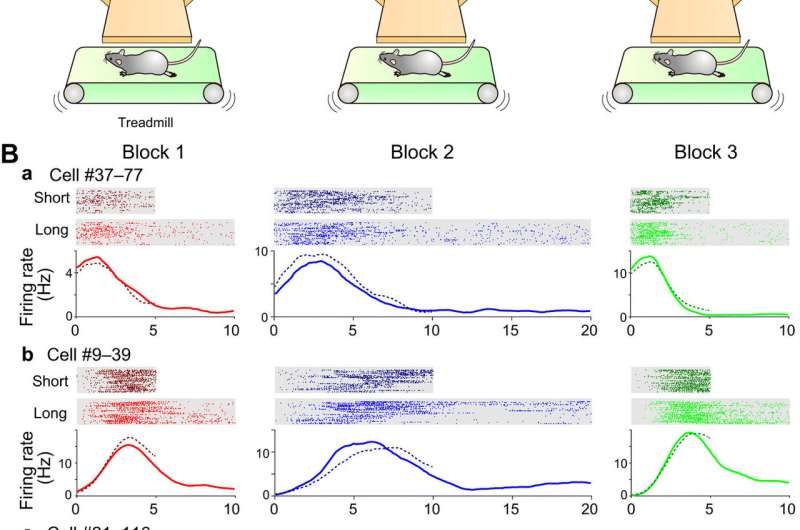
CA1神经元在时间等分任务中的可扩展时间表示。(A)任务示意图(任务1)。让大鼠在跑步机上长时间或短时间跑步,然后分别选择长时间或短时间与水奖励相关的左臂或右臂。第1组和第3组的间隔是10秒(长)和5秒(短),第2组的间隔是20秒(长)和10秒(短)。(B, a到c)块1(左)、块2(中)、块3(右)三个代表性时间单元的放电模式。上图:长间隔和短间隔试验的栅格图。底部:长间隔(实线)和短间隔(虚线)试验的PETHs。(C)第1块(左)、第2块(中)和第3块(右)的时间细胞放电模式(n =来自7只大鼠的454个单元)。每一行表示每个块中单个神经元在长间隔试验中的peth。颜色刻度代表每个神经元的放电速率。神经元按照第1块中的峰值时间排序。 (D) Population vector analyses of the data (C). Left: Autocorrelation of the population vector matrix of block 1. Center and right: Cross-correlations of blocks 1 and 2 and blocks 1 and 3, respectively. The color scale represents Pearson’s correlation coefficient. (E) Distributions of the scaling factors of time cells between blocks 1 and 2 (blue) and blocks 1 and 3 (green). Credit: Science Advances, doi:10.1126/sciadv.abd7013
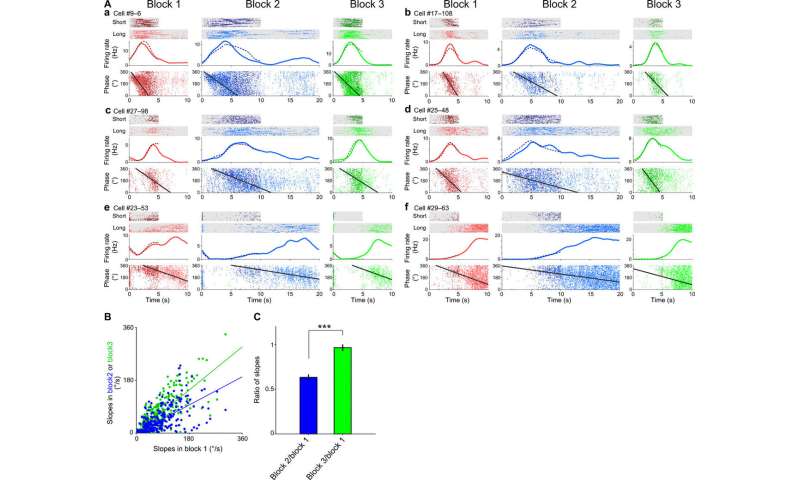
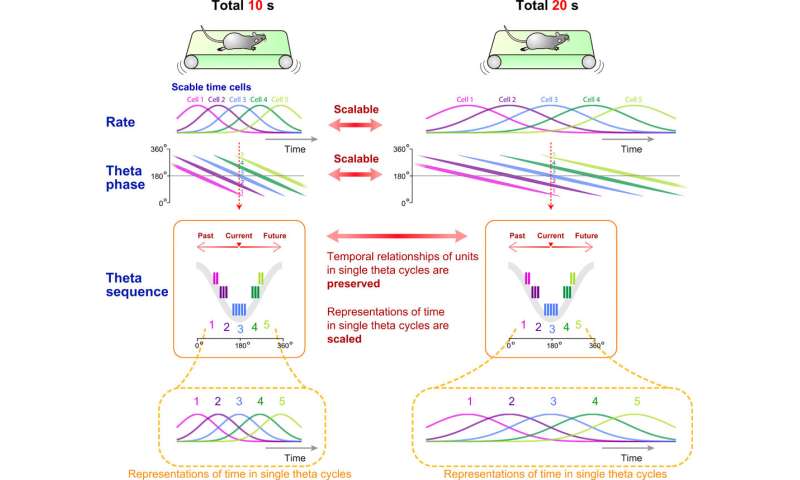
时间单元相位进动的可扩展性。(A, A to f)任务1中block 1(左列),block 2(中列),block 3(右列)中三个代表性时间单元的发射速率和θ相。上图:短间隔和长间隔试验的栅格图。中间:长间隔(实线)和短间隔(虚线)试验的PETHs。底部:相位图作为运行时间的函数。每个点代表长(浅色)和短(深色)间隔试验的动作电位。每个面板中的黑线表示数据的圆形-线性拟合(见材料和方法)。(B)任务1中每个单元(n = 351个单元)中块1和块2(蓝点)之间以及块1和块3(绿点)之间相位进动斜率的关系。实线表示这些数据的线性回归拟合。(C) block 2中每个cell的相位进动斜率除以block 1中的相位进动斜率(蓝色)。 Slope of phase precession in each cell in block 3 divided by that in block 1 (green). Means ± SEM. ***P < 0.001, paired t test. Credit: Science Advances, doi:10.1126/sciadv.abd7013
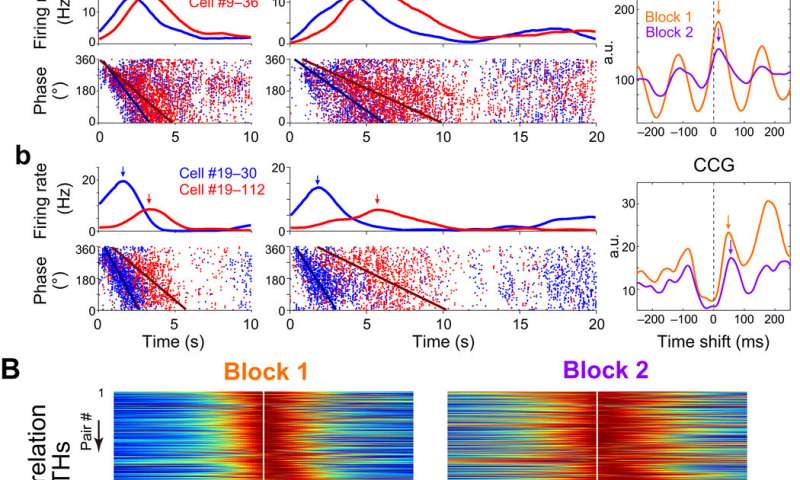
单θ周期内尖峰序列的时间压缩的两两分析。(A, A, b)左:第1块和第2块(任务1)中两对具有代表性的时间单元(红色和蓝色)的发射速率和θ相。箭头表示发射速率峰值。右图:第1块(橙色)和第2块(紫色)中对的交叉相关图(CCGs)。箭头表示ccg的峰值。请注意,(Ab)的CCG峰值时移比(Aa)(右)的更大,反映了(Ab)的PETH峰值时间比(Aa)(左)的更大距离。A.u,任意单位。(B)时间单元对peth的相互相关性。(C)第1块和第2块成对时间细胞的ccg (n = 694对)。在(B)和(C)中,对的顺序相同。(D)在区块1和区块2中,对单theta周期中spike序列的时间压缩进行成对分析。每个点代表一个神经元对。 Horizontal axes show peak distances of PETHs, and vertical axes show peak shifts of the CCGs. The slopes of the regression line (red) were 29.2 and 15.0 ms/s in blocks 1 and 2, respectively. (E) Relationship between the time shifts of the CCGs from blocks 1 and 2. The slope of the regression line (red) was 0.98. Credit: Science Advances, doi:10.1126/sciadv.abd7013


用户评论