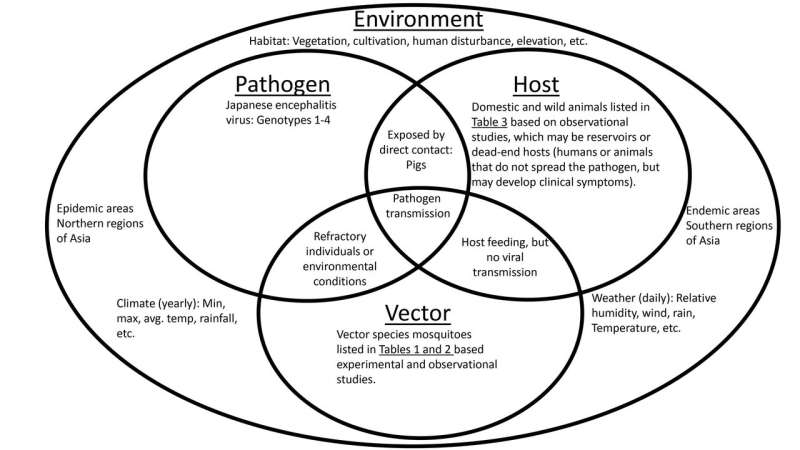
In a new article in the Annals of the Entomological Society of America, researchers at Kansas State University and the U.S. Department of Agriculture recommend the adoption of an enhanced "epidemiologic triad" for vector-borne diseases -- i.e., those spread by insects and related arthropods, such as mosquitoes and ticks. This depiction, using Japanese encephalitis virus as an example, demonstrates that controlling the vector is as important as controlling the pathogen or treating the hosts. "Rather than focusing on managing diseases at the host or pathogen level, we suggest the focus should be at the environmental and vector levels, an approach known as integrated vector management, or IVM," says Natalia Cernicchiaro, DVM, MS, Ph.D., assistant professor in the Department of Diagnostic Medicine and Pathobiology at Kansas State and senior author on the report. "Management strategies applied at these levels tend to be more sustainable and effective." Credit: Annals of the Entomological Society of America
Ana Oliveira,DVM,M.S.,Lead Auditor关于报告和目前在堪萨斯州的研究顾问和合作者,首先在她的论文工作中提出了增强的流行病学三合会。新型模型而不是考虑向环境的载体,而不是考虑到环境的子集,而是对载体传播疾病的传播中的载体,病原体和宿主进行了相同的重点,这一切都在其普遍环境的影响范围内。


用户评论