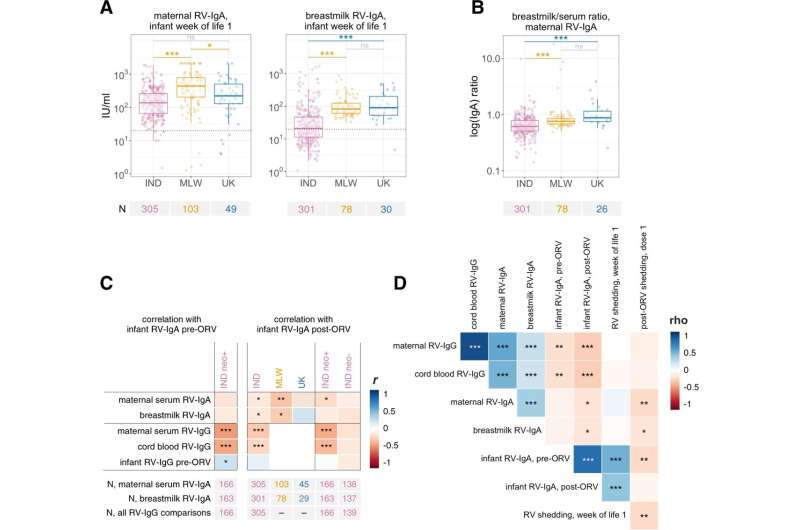
母亲的抗体和口服轮状病毒疫苗的反应之间的联系。母体抗体浓度的地理差异。与因果图基组比较,方差分析测试。20国际单位/毫升的虚线表示的标准截止RV-IgA血清阳性。B地理差异孕产妇母乳/血清RV-IgA比率。组相比,邓恩的测试。使用对数转换比率计算抗体浓度。见图1盒须图参数的传奇。C孕产妇抗体和婴儿RV-IgA形成之间的联系。浓度对数转换比较使用皮尔逊相关系数(r)与双边假设检验。 Infant samples for RV-IgA measurement were collected at the time of dose 1 (week of life 6 in India/Malawi; week of life 8 in the UK) and 4 weeks after dose 2 (week of life 14 in India/Malawi; week of life 16 in the UK). D Correlation between rotavirus-specific antibody concentrations and rotavirus shedding in Indian infants with complete data (n = 298). For shedding variables, 1/Ct was used such that higher values correspond to higher rotavirus quantities. Shedding after week of life 1 was determined based on the group A rotavirus VP6 gene assay (Ct range 23.5–35.0) while shedding after dose 1 was based on the Rotarix-specific NSP2 gene assay (Ct range 20.7–40.0). Variables were compared using Spearman’s rank correlation coefficient (rho) with two-sided hypothesis testing. neo+, infected with rotavirus neonatally (defined by detection of rotavirus shedding in week of life 1 or baseline seropositivity); neo−, uninfected with rotavirus neonatally; ns, not significant; ORV, oral rotavirus vaccine; RV, rotavirus; *p < 0.05; **p < 0.005; ***p < 0.0005. Credit: DOI: 10.1038/s41467-021-27074-1